



Along its rugged coastline, where cliffs meet the Atlantic and the wind carries salt across the land, stories were never separate from daily life. They were not entertainment. They were not decoration. They were a way of understanding a world that could not be controlled.
Before maps became precise and forecasts reliable, the sea was both provider and threat. It fed entire communities, yet it could take everything in a single storm.
In such a landscape, it was only natural that people began to speak of something that lived between the land and the water.
Something that could not be seen, yet was always present.
This is where the legend of the Bucca begins.
The Bucca is a figure from Cornish folklore, often described as a sea spirit associated with coastal communities and the unpredictable nature of the ocean.
Unlike many mythological creatures, the Bucca belongs to a grounded world – shaped by labour, weather, and survival. It is not a distant god. It is something closer.
In traditional descriptions, the Bucca is not fixed in form. It is often understood as a presence rather than a creature – something felt rather than seen. In later interpretations, it appears with both protective and dangerous aspects, reflecting the dual nature of the sea itself.
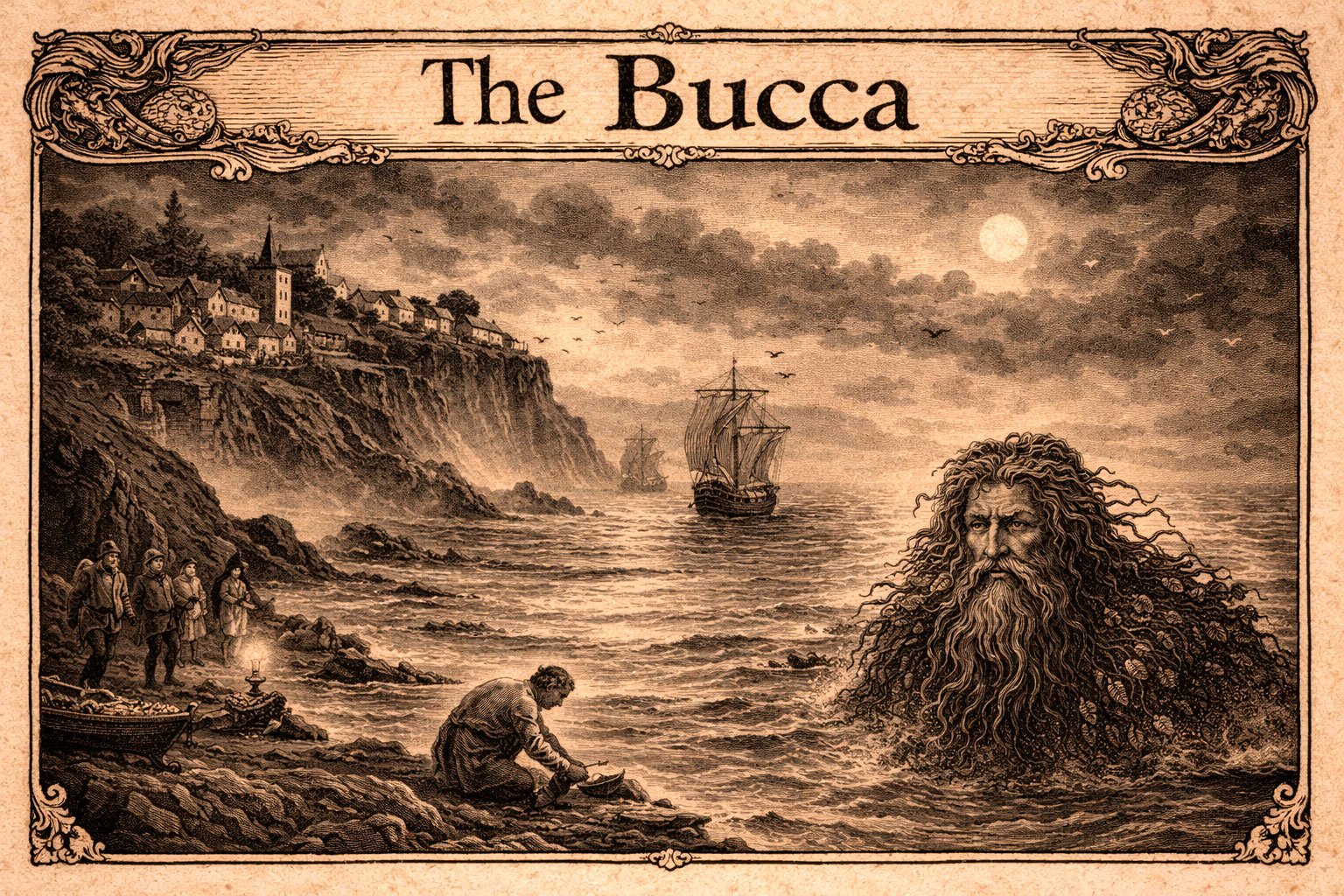
The Bucca does not have a single clear origin. Like many myths and legends of Cornwall, it developed through oral tradition long before being recorded.
One of the earliest written references appears in the Cornish-language play Gwreans an Bys (1611). However, this marks documentation – not the beginning. By the 19th century, folklore collectors began documenting local stories more systematically, revealing a rich and evolving belief system around the Bucca. Different coastal communities described it differently. But its connection to the sea remained constant.
To understand the Bucca, it is essential to understand coastal life in Cornwall.
Fishing was not just an occupation – it was survival. The sea provided food, but it also brought danger. Storms could arrive without warning, and entire livelihoods depended on unpredictable conditions.
In this context, the Bucca became part of a wider system of belief.
In some traditions, fishermen left offerings on the shore, often a portion of their catch, as a gesture of respect. This was not worship. It was balance.
A recognition that taking from nature required giving something back.
Over time, the Bucca came to symbolise something deeper than a myth.
It represented balance.
Between:
Some later interpretations describe two aspects of the Bucca – one benevolent, one more dangerous. Whether this duality existed from the beginning or evolved later, it reflects an essential truth:
The sea itself is never one thing.
In some local traditions, a darker form appears – the Bucca-boo.
This figure carries a more unsettling presence, associated with fear, warning, and unpredictability.
These stories served a purpose.
They were not just tales – they were a way to communicate risk, to teach caution, and to remind people of the limits of human control.
Folklore, in this sense, becomes a language.
Today, the Bucca is part of a wider network of Cornwall folklore, alongside figures like piskies and knockers. Yet it remains distinct. Less decorative. Less commercial. More grounded.
In modern interpretations, the Bucca represents something essential about Cornwall:
For visitors searching things to do in Cornwall, these stories may appear as cultural details. But for the region itself, they are part of identity.
At first glance, the Bucca may seem like a relic of the past. But its meaning is deeply contemporary. The idea of balance – of respecting natural systems, of taking only what can be sustained – resonates strongly today. It reflects a way of thinking that is slower, more attentive, and rooted in place.
The name BUCCA MOR is not symbolic in a superficial sense. It reflects a principle.
The Bucca represents the balance between:
This idea is central to everything:
BUCCA MOR does not recreate the myth.
It follows its logic.

The Bucca endures because it expresses something essential:
For those exploring Cornwall travel experiences, this may be felt in subtle ways – in landscape, food, and atmosphere.
For those who live here, it is foundational.
The Bucca was never just a creature. It was a way of understanding the world. And in Cornwall, that understanding never disappeared.
It changed form.
From story to practice.
From belief to principle.
From legend to lived experience.
This website uses cookies to improve your browsing experience and understand how visitors use the site. You can accept or decline non-essential cookies at any time.