The Journey Behind BUCCA MOR
Share:

- Posted on

Some journeys begin with ambition. Others begin with a question. It is easy to believe that people simply decide who they are going to become; that one day someone chooses to be a chef, an artist, a writer, or perhaps the owner of an independent freehouse on the Cornish coast.
Life, however, rarely follows such orderly lines. More often it unfolds gradually, shaped by places, experiences and quiet moments that seem insignificant at the time but later reveal themselves as the foundations of everything that follows.
Some lives resemble carefully drawn maps. Others are more like rivers, twisting unexpectedly, disappearing beneath the surface for a while before emerging somewhere entirely new. Looking back, every turn appears to make perfect sense, yet while living through it, the destination is rarely visible. Perhaps that is why the story of BUCCA MOR does not truly begin with a building, a menu or even with Cornwall itself. It begins much earlier, with something far more difficult to define: the search for belonging.
Finding direction without a map
There is a quiet difference between those ideas. Some people grow up exactly where they instinctively feel at home. Others spend years—sometimes decades—moving between landscapes, languages and identities before recognising that one place has been patiently calling them all along. Looking back at Max Rosenberg’s journey, it is tempting to connect the milestones into a neat biography. Estonia. Europe. The Isle of Wight. Cornwall. Professional kitchens. Freehouses. Awards. Years spent travelling, learning and refining a craft. It is the kind of story that fits comfortably onto the back of a menu or an “About” page.
Real life is rarely that tidy.
Early influences and everyday lessons
The experiences that shape people usually begin long before careers, long before success and long before anyone else notices. They begin in ordinary routines that seem too small to matter until years later, when they quietly reveal the philosophy they have been building all along.
Born in Estonia during the final years of the Soviet Union, Max grew up in a world where limitation was simply part of everyday life. Choice was never abundant, freedom was never taken for granted, and resources were valued because they had to be rather than because sustainability had become fashionable. Respect for food, for tools, for fire and for the rhythm of the seasons was not a culinary philosophy or a marketing idea. It was simply the way life worked.
Childhood has a curious way of shaping people. We often imagine that lives are transformed by extraordinary moments, yet it is usually repetition that leaves the deepest impression. The sound of wind moving through forests. The smell of woodsmoke after rain. Fishing because that is simply what people do. Heating the sauna before night falls. Watching adults repair instead of replace. Cooking with what is available rather than what is desired. None of these moments announces itself as important, yet together they slowly become something much larger than memory. They become instinct.
Years later, those same instincts are often described using words such as provenance, seasonality, sustainability or local sourcing. As children, however, they rarely need names. They are simply part of everyday life.
Perhaps that is why the philosophy behind BUCCA MOR feels so natural. It was never invented during a branding workshop or written into a business plan. Long before there was a logo, an independent Cornish freehouse or a vision for coastal dining in Cornwall, many of its values had already been quietly taking shape through lived experience.
A defining memory of hospitality
Among the many milestones in Max’s story, one memory stands apart. It is not a Michelin-starred kitchen. It is not Noma. It is not running a freehouse or professional recognition. Instead, it is the memory of a friend’s mother preparing simple meals at home a kitchen where generosity mattered as much as skill, and where ordinary ingredients became unforgettable simply because they were treated with care.
There is something quietly profound in that memory because it reminds us that our understanding of food rarely begins in great pubs or freehouses. It begins around family tables, beside people who never expected to become anyone’s inspiration. Long before pubs teach us what flavour is, home teaches us what hospitality feels like. Perhaps every chef spends years trying to recreate that feeling. Not the recipe itself, but the feeling it leaves behind.
A language before a profession
It would be easy to describe the next chapter simply as the beginning of a culinary career, but that would overlook something far more interesting. Cooking did not suddenly appear as a profession. It had already existed as a language a way of expressing memories that had been forming long before the first professional kitchen entered the story. Every new technique, every ingredient and every lesson learned along the way became another word in a vocabulary that had started much earlier.
Travelling across Europe and eventually settling in Britain expanded that vocabulary even further. New ingredients appeared, different traditions emerged and opportunities opened the doors to some of the world’s most respected kitchens. Yet even those experiences feel less like moments of reinvention and more like moments of recognition. Rather than replacing what had come before, they gave shape to ideas that had quietly existed for years.
Places such as Noma have become famous for demonstrating that a landscape can become the foundation of a menu; that a place does not have to imitate somewhere else to be remarkable. Instead, it can speak with the voice of its own surroundings. The forests, coastlines, changing weather and local producers are no longer simply part of the backdrop – they become the story itself, expressed through flavour, texture and seasonality.
The power of attention
There is something deeply reassuring about that idea because it suggests that the most meaningful food does not begin with complexity. It begins with attention. Attention to where ingredients come from, to the people who grow them, to the fishermen who leave harbour before sunrise, to the changing rhythm of the seasons and to the landscape that quietly shapes everything placed on the table.
A philosophy that continues
Perhaps that is also why the philosophy behind BUCCA MOR feels less like a concept and more like a continuation. Independent hospitality in Cornwall is not simply about serving food or pouring drinks. It is about creating a place where the landscape remains visible in every decision, whether through locally sourced ingredients, seasonal menus or the relationships built with Cornish producers. A freehouse has the freedom to choose its own path, and that freedom carries a responsibility to reflect the community around it rather than follow expectations from somewhere else.
Food as a way of recognition
Over time another idea slowly began to emerge. Cooking had never really been about impressing people. It was about helping them recognise where they were. A meal could become an introduction to a landscape, a conversation with the sea or a reflection of the people who farm the land, harvest the orchards, gather wild ingredients or patiently wait for the right season to arrive. Good food has a remarkable ability to tell stories without needing to explain them.
That understanding eventually found its expression in Heima. Interestingly, the word itself carries the meaning of home, although not in the sense of a building. It speaks instead about a feeling – a place where everything seems quietly connected. Looking back now, it almost feels impossible that BUCCA MOR could have existed before that chapter. Some places become destinations, while others become preparation. Heima belongs to the latter. It was not the conclusion of a journey but the place where years of experience, observation and curiosity finally discovered a shared language.
The meaning behind the name: BUCCA MOR
Seen from that perspective, BUCCA MOR begins to feel less like a new project and more like the natural continuation of everything that came before. Every stage of the journey contributed something: childhood shaped values, travel broadened perspective, professional kitchens refined technique and Cornwall offered the landscape where those experiences could finally belong together. Not as separate achievements collected over time, but as pieces of the same story, gradually finding their place.
Perhaps that is why BUCCA MOR feels different. It was never created simply because another place was needed, nor because opening an independent freehouse in Cornwall seemed like the next logical step. It emerged because, after years of travelling, learning and quietly observing, there was finally a place where philosophy, landscape and hospitality could exist as one. Like the Cornish coastline itself, it has been shaped by time rather than haste, weathered rather than polished, and confident enough to speak quietly without ever needing to announce its importance.
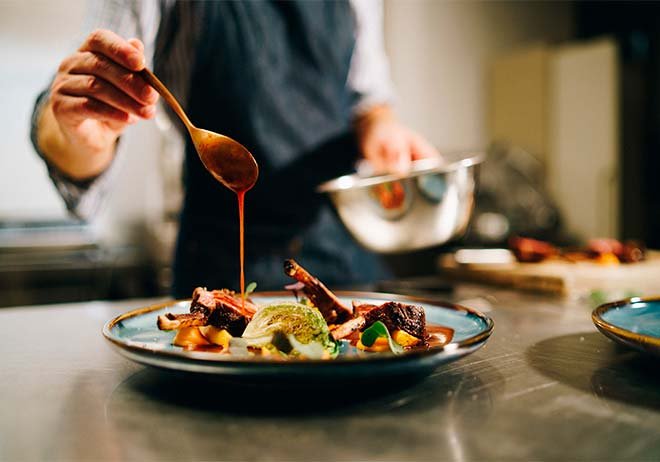
Every story has two sides. One is shaped by experiences, memories and the ideas that quietly influence the way we see the world. The other is built through years of professional practice, working alongside remarkable people, refining techniques and developing a craft.
If you would like to explore the professional path behind BUCCA MOR in more detail, you can discover more about Max Rosenberg’s culinary career, experience and achievements below.